Showing posts with label weekend. Show all posts

Sunday, October 30, 2011

Going to Gyeongju II: Hiking Namsan and Other Soul Satisfying Fare

Our day trip begins at a traditional restaurant that had obligingly opened early to accommodate our group of six. As soon as we settle down onto the floor mats, side dishes (called banchan, 반찬) and mountain vegetable bibimbap (sanchae bibimbap, 산채 비빔밥) mix-ins start arriving on our table. This will be our fuel during the all-day hike ensuing right after breakfast.  Today is devoted to conquering Namsan Mountain in Gyeongju.


A bowl of sanchae bibimbap starts with a bowl of sticky white rice topped with vegetables. Ours had spinach, bean sprouts, onions, mushrooms, and various unidentifiable green and twiggy mountain vegetation. To that, we each add some red pepper paste (gochujang, 고추장) or fermented soybean paste (doenjang, 된장).  


I ate up all the spicy, tangy-dressed lettuce salad and most of my bibimbap. Our other banchan included green pancakes, fried zucchini, marinated mushrooms, fish, radishes, and more. At the end, we were treated to some homemade sweet rice drink, which I'm pretty sure is called shikhae (식헤). It was light and sweet and cold, and really really delicious.
                                                                                                                                                          From the restaurant, we started onto Namsan Mountain's (남산) western face, entering near three mounds that are the Samneung Three Royal Tombs (삼릉). These tombs hold the remains of three Silla Dynasty kings: Adalla, Sindeok, and Gyeongmyeong, the 8th, 53rd, and 54th rulers, respectively.


Just a short way up the Samneung Valley (삼릉골) trail that would lead us further and further into the Namsan District of Gyeongju National Park, we see our first Buddha of the day, perched up straight but whose head was taken from him at some point.  
                          
After this one, we pass a handful more of the Buddhas scattered over Namsan. They look relaxed and untroubled. Our group stops and takes photos at each, admiring how long they've been there and the care it took to carve and assemble them. My favorite is pictured below. He's the Seated Stone Buddha, sitting on a lotus petal and expelling evil by touching the ground. It was made in the 8th or 9th century, with some restoration work done just a couple years ago. 


Next, we encounter six figures etched onto the side of a rock. Two are Buddhas, four Bodhisattvas. We have to study the rock for a few minutes to allow our eyes to follow the intersecting lines.


The most awe-striking Buddha of the day is the seven-meter-tall seated Seokgayeorae image carved on the side of Namsan. He directly looks at the Geomobong peak. Our hike takes us directly past the Buddha, and later on, we get a second view from higher up.


When we make it to the peak, we stop and fuel up with some PB&J's. There's no view from this peak, since we're completely surrounded by forest at this moment. The first treasure on our descent is this three story stone pagoda. The view from here is incredible. There used to be a temple here where the first Korean novel, Geumosinhwa, (written in Chinese) was authored. 


Our hike gets a little tenuous when we have to perform some fancy repelling action. Actually, the whole little part where you need the rope is maybe eight feet tall, but still, awesome.


The last major Buddha we pass on the way down is a seated stone Buddha from the eighth century. Like his friend from earlier, his head has gone missing sometime over the years. He's sitting atop a three wheel pedestal.


We're all famished after our hike, so we hop on the city bus and head toward the more central area of Gyeongju. Dwayne and Yuhee lead us to Sampo Ssambap (쌈밥) Restaurant for a little lunch. Ssambap is when you take some sort of leaf, maybe lettuce or cabbage, and wrap it around some rice, a little meat, condiments, banchan, whatever your preference is. This is awesome in an of itself, but this place was serving up ssambap to the extreme! Out came bowl after bowl after bowl! Side dishes, pastes, fish, meats, custards, until the dishes were completely covering our table! And all this for ₩10,000 per person (aprox. $9). 


After dinner, not quite ready to end our day, we go to one more place for a drink before home. We walk along the backside of a park until we happen upon a restaurant. The place is packed, and rightly so. It's incredibly atmospheric, an open-air restaurant with courtyard tables as well as private tables in side rooms. It's called Dosol Maeul (도솔마을), which means "Stone Pot Village."


We order an appetizer, a mixed tempura-fried vegetable platter that included some tofu and lotus, and some Korean rice wine, dongdong ju (동동주). We are told that dongdong ju is makkeoli's more formidable cousin in terms of it's strength. The taste is unique but really refreshing and delicious. 맛있어요!


When we're all sufficiently fat and happy from the snacks, drinks, and fresh air, we start our walk back toward the intercity bus terminal. Once again, Gyeongju has been a revitalizing and relaxing respite away from Busan. I'm sad to see the day over, but there will be at least one more trip back in our future. 


For more on visiting Gyeongju, see my post on our first trip there.

Wednesday, September 28, 2011

It's Soju Cocktail Hour: The Watermelon Soju Cocktail

With the warm weather slowly trickling away, we thought our nights of watermelon cocktails were gone for the year. After all, out of season watermelons retail for around twenty dollars, and although these drinks are good, I shudder at the thought of $20 watermelons. So it was a nice little moment of serendipity when the fruit truck guy who parks across from our hagwon had late season fresh watermelons for 4,000 won. True to form, we turned one into cocktails. Here's how to make some of your own, should you be lucky enough to stumble across a melon.

Chunk up that watermelon.
Take out as many seeds as you can along the way.
 The melon reduces down as you blend it,
so you might need more than you think.
Eyeball it.
We added some frozen strawberries
to thicken it up.
It's optional.

Add around a teaspoon
of sugar.

Squeeze that lemon or lime.
It's going to need some zing
.


Throw in a shot of soju per cocktail.
Or more, your call.
Give it all a blendaroo. Check and see if you need
more sugar or lime by taste.
If you're all good, pour it out and drink it up.
Don't you want to go make one right now?

Friday, September 16, 2011

This is Our Dog - Diga

Let me tell you about a little white scruffer that Rose and I call Diga. For the last few years, Rose and I have really wanted to get a dog. At our place in Madison, we couldn't get a dog, and that really sucked. As we were getting ready to leave for Korea, we found out that many expats abroad adopted dogs. This sounded amazing to us, but we weren't sure how easy or practical it would be for us. The rest of this article is the story of Rose and I expanding our family. 
                                                                                                      
After we arrived in Korea, we spent the first six months adjusting to life abroad. If you read our blog in the early stages, you know what we were up to, if not, go back and check the back catalog. We looked around the interwebs to find dog resources in Korea and would be in delight when we crossed a cute dog on our walks down by the stream. We watched Best in Show a number of times when thinking about getting ready get our dog.                                       
                                                                                                                              
We found out about the Busan Abandoned Pet Sancuary, better knows as BAPS. BAPS is operated by a few wonderful people, including Leo and Jin (our expat friend and his lovely Korean wife). They took over the shelter three years ago and it has been getting better and better ever since. They have fully ingrained themselves in the community and get regular volunteers on Saturdays and Sundays to help out at the shelter. They are a shelter that truly cares about the dogs they take in. Their band of strays covers many types of breeds and sizes. They are a no kill shelter and have always been a shelter that does not charge an adoption fee. They have 30 or so dogs there at any one time and 15-20 out in foster care or on their way to adoption. They take in new dogs when they can. One of the more grim ways that dogs end up at BAPS is that they are rescued from the dog meat markets. Dog meat is technically illegal in Korea, but it can still be found in back alley restaurants off the menu. 
                                                                                                      
BAPS is a fantastic organization that helps many dogs and gives many a fantastic volunteering opportunity. If you are living in Korea and you are interested in volunteering for this great organization find them on facebook.com and get involved. They have donation baskets at many popular spots around Busan, please donate and support. If you are living elsewhere in the world and would like to learn more about them, check out their website to see some pictures and learn about the dogs who live there.                                         
                                                                                                                             On our first trip to BAPS we were hoping to take a dog home with us that day, but they wanted us to wait to find a dog that worked well with us and they also wanted to get to know us a little better. Some of the dogs are still there from when Leo and Jin took over three years ago, and one of those dogs was Diga.


Diga was the first dog that Rose came to. We harnessed Diga and another dog that looked just like him up and we started down the road. Diga moved slow, very slowly, and shortly after Rose and I switched dogs, Diga put on the brakes and refused to walk anymore. Something about it was so sweet and endearing. The little pup felt so meek and mild that the three of us (Rose, myself, and the-not-yet-named Diga) formed an instant connection. Little Diga jumped up on our laps and just wanted to sit and be cuddled. He had to come home with us. 
                                                                                                        
The next week we were back at the shelter and we made the decision to take him home with us. But this was just the beginning of the journey. We had to make a stop at the vet's office to get a full check over and haircut. Our shaggy dog became a little pink rat. He needed all his hair taken off because much of it got matted from the winter spent in the greenhouse. Now he would be cold if it weren't for... dog clothes. One of Rose's new favorite things, not my favorite, but useful for such a little dog out in the cold.
                                                                                                       
That vet told us we would need to find another vet in our area to look after Diga's issues. He had some skin problems and a pretty nasty ear fungus. Our coworkers at the hagwon helped us find an English speaking vet only five doors down from the school. Pretty nice!
                                                                                                         
Dr. Pi (pronounced pee, but not spelled that way) is a very kind man, who has taken great care of Diga. They do grooming there as well and have given (at our request) Diga a pretty sweet mohawk. Also, at many vets offices around Korea, they have a dog who lives right at the shop. Dr. Pi's is Meng, an extremely little tea-cup shih-tzu that weighed all of 3.5 lbs. He's Diga's friend, and very funny.
                                                                                                         
We saw Dr. Pi quite often the first few months with Diga, his ear problems took a while to heal up and he had some stomach problems, which were probably mine and Rose's fault. But he's been great for the last few months and we've barely seen Dr. Pi except around the neighborhood. And he always asks how little Diga is doing.


Diga is a constant source of entertainment, both at home and when we are teaching at school. Many of our students have met Diga, and even if they haven't, they are always asking questions about him. When we read stories in class, if there is ever a dog, doesn't matter the size or color, we usually call it Diga. Many of the students have taken to this as well, so I guess it's a good thing that the Clifford books have yet to catch on in SLP.
                                                                                                       
Diga is one happy guy who loves to cuddle and loves to bring happiness into our lives. We miss our families so much, and Diga being here has made it easier. He is a new member of our family, and he fits in great. I never knew how nice it was to be needed, but Diga has made me realize how great it is.


In a short while, we'll be headed home with our little scruffer. It will be a long flight and hard work, but we couldn't imagine leaving him here. He has become an important part of our lives. As Rose and I grow as a couple, we've been excited to see our family grow. So thanks to Diga. I'm glad he's a part of our lives.

Monday, September 12, 2011

Sitting on Songjeong

In the spirit of summer (or rather, the recent end thereof), I thought I would share one of my favorite discoveries from this too quickly gone by summer season: Songjeong Beach, tucked up on Busan's eastern coast in the Haeundae area. Remember how I barely updated at all this summer? Yeah, I was here.
                                                                                                         
Fun Fact: The sand on the beach is soft and fine, unlike the sticky, coarse sand at Gwangalli and Haeundae, Busan's two more famous and more accessible beaches. When you go to Gwangalli or Haeundae, you better be prepared to spend the rest of the day with tiny shell chips and and sand stuck to your legs, clinging to your skin for dear life. Unlike those two, Songjeong's sand isn't trucked in. This is the real deal (read: it's not a man-made beach). It feels nice under your bare feet. And it falls right off your legs easily when it's time to go home. 
                                                                                                         
Fun Fact: Unless you have your own vehicle, you're going to spend a bit of money on a taxi or time on the bus, depending on your starting point. The closest the subway gets is the last few stops on the green line. No fear, your travel efforts will be handsomely rewarded. Because Songjeong isn't completely overrun with tourists, the scene is much less developed than those other aforementioned beaches. For example, you can find like three or four chain coffee shops instead of twenty. Your food options are more limited to Korean restaurants, toast stands, or the couple of convenience stores. Songjeong is Busan's "family beach." 


Fun Fact: If you go on a crowded day, and are searching for a precious front-row parasol (because why in the world would you want someone blocking your view of the water), go ahead and keep on looking in the crowded area. There were large sections at Songjeong that looked to us like they had plenty of room for us to nestle in. We lacked the proper military credentials, though, that would have allowed us to park it in that special section.


Fun Fact: The water is more blue here than anywhere else we've seen in Busan so far, except Igidae. The teal water and the mountains made for some rad scenery. Plus, there's a banana boat that you can zip around on AND you can camp here. Awesome.
                                                 
Fun Fact: Diga loves the sand, hates the water. Shane mostly loves the water. It's pretty shallow here, but if you go far enough, you can actually swim. Don't get too close to the buoy, or those jet-ski lifeguards are coming your way.                                       
One perfect day, splashing around, he was asked by a gaggle of pretty university girls why he wasn't at Haeundae, where the "girls wear bikinis". He also may have appeared on a TV show, but we will never know. Yes, a random man sat down next to him, egging him on to.... something.... while another filmed it all on a film-making camera. "Fighting!" the man prompted! "Fighting!" Shane repeated! Oh, put down the beer, do it again. Can't have alcohol in the shot. "Fighting!" the man prompted! "Fighting!" Shane repeated! Something something something in Hangul. One more time. "Fighting!" the man prompted! "Fighting!" Shane repeated! They weren't interested in my ability to yell "Fighting!". I stand awkwardly out of camera range. These things happen to Shane.


I can only hope that 2011's warm weather stretches long into October like last year. Beach season may be over for everyone else, but for me, Songjeong is still waiting.

Sunday, July 24, 2011

Sister Visits Busan

Note: This guest post was written by my sister, Crystal, who visited Busan with her husband, Nick, back in March 2011. We thank her for her contribution to Soju Cocktail and for visiting way over here.

A lot has changed since we left Busan on March 14th; we found out that we are having a second baby, we traveled to Arkansas for yet another music festival and we traded our responsible family station wagon in for a “ridiculous” VW bus in which to create family memories. 
But one thing that hasn’t changed since then is how much I loved getting the invitation and opportunity to travel across the world to visit Rose & Shane. Visiting South Korea is something Nick and I would have never done if it weren’t for family being there. I’m super glad that they decided to become temporary residents in what Rose calls “The Land of Contrasts” so that we were able to enjoy all that Busan has to offer.
The contrasts Rose was talking about were instantly apparent. One of the most memorable was the obvious division between the generations of women, the younger generation obsessed with perfecting their faces while the older generation was obsessed with gutting their fish. I never encountered a young lady who didn’t have her eyeliner on to go hiking, and I rarely laid eyes on an older woman who could stand straight after squatting over a pail of fishy entrails. It wasn’t just the people that showed these contrasts, but the scene itself. The bustling city streets set itself against peaceful mountain paths in a way that kept making you forget that the other even existed. Then there were the modern technological advances surrounded by the remnants of past wars; people were taking pictures of rusted barbed wire fences with what looked like a smaller, better Ipad. It was magnificent. And it was fun.
The first night we arrived, Rose & Shane took us to a Korean BBQ. As I will most likely say about almost everything we did while in Busan, the Korean BBQ was definitely one of my favorites. The family-sized portion of meat comes to you raw and then you cook it yourself on a hot skillet or grill set in the middle of the table. When done to your liking, you wrap it in lettuce or sesame leaves and choose your other assorted toppings, like roasted garlic, kimchi, or a spicy sauce. You eat the little wrap with a nice, light, watery beer named Cass or with Soju. I liked the BBQ so much, I requested to go back at least three more times during our visit. 

The next two days were spent at temples. The first temple we visited, Beomeosa, is the temple all the traveler’s websites tell you to go to. Although impressive and large, it was nothing compared to the temple we visited next, Hae Dong Yong Gung. Hae Dong Yong Gung is set atop a rocky shoreline of the Sea of Japan. It has many multi-sized Buddhas, fresh spring water to drink, beautiful temples and scores of worshipers. It was a place to be at peace.
It was not quite so peaceful when we made the trek back in the city. We visited the busy markets in the streets and sampled different street foods. Every street was packed with hungry people looking to buy and sell goods and services.  Although they all looked exactly the same in my eyes, Shane was able to bring us to one 3x5 table that was making these crazy pancake type dishes, filled with chives and who knows what else. I will have to say, whatever they put in there, it was delish.  
One of the great things about Busan is that even though it’s a busy city, it only takes the short walk of a block to get back to peace. The city is on the shoreline, so we were able to spend some time on the beaches as well. Even when in a winter jacket, a beach is relaxing. Watching the water come in, writing messages in the sand, taking pictures with your friends to put on your next record cover, life is good when you’re on the beach.
Did I mention this was all just in the first 2 days?

Thursday, June 23, 2011

Baseball Top Ten: How Busan Does America's Game

Our first adventure to Sajik Stadium was just that, an adventure. The songs, the food, the cheers, and the pageantry were all on display. Here's my top ten list of things that make Korean professional baseball (Busan Lotte Giants specifically) great.
                                                                         10. My students' Dads play for
the team - No joke here at all. Two of my students have dads that play for the Giants. I don't think it's right to say who they are, but one of them starts in the field and the other is a relief pitcher. It's really cool to hear about. Every once in a while they'll come in to class super excited and tell me, "My father struck out two batters!" or "My father hit a home run!" It's pretty freakin' awesome, to tell the truth.
                                                                        9. Foul balls go to kids under 8. This is a strict rule. Any time a foul ball goes into the stand, everyone chants at whomever caught the ball to give it to a child, specifically one under eight years old. A student of mine, Harry, once told me how he got a foul ball at the game. Harry is 11, and he was too old for the crowd. He said he wanted to keep it, but was forced by the crowd to give it to a younger spectator a row ahead of him.
                                                                                                                             8. Scantily clad bat-girls - Back in America, the role of bat boy is usually filled by a player's son. Here, bat girls add to the entertainment of the entire evening,  at least for the first viewing of a Korean baseball game.
                                                                                                                             7. There are many a song to be sung -
The lyrics are in
Korean and made to fit the players' names. There's a bunch of classic, standard songs made into cheers: Champs-Elysee (classic French), Glory Glory Hallelujah (classic religious), Rivers of Babylon (classic rasta), If You're Happy and You Know
It (classic kindergarten), Cum on Feel the Noise (classic crappy-glam-metal), What's Up (classic 90's 4 Non-Blondes), all culminating in The Maple Leaf Rag (classic Joplin). Plus there are songs for when common things happen on the field, for example, an out at first base:  "Oh-Noo-Nai" which translates to "Someday."
                                                                                                                           
6. Mini Cooper bullpen cars. In the 80s and early 90s, bullpen cars were used to usher relief pitchers to the mound in the MLB. Being the Brew Crew fan that I am, I remember seeing Jose Orosco being driven up to the mound in the sidecar of a Harley. Here in Busan, the local BMW dealership sponsors the bullpen car, a Mini Cooper convertible. It's pretty awesome to see. I'm a big fan of bullpen cars in any form. Especially if it's a car for high school girls and men going through midlife crises.
                                                                                                                  5. Convenience stores in the stadium with my choice of beer. Do you hate paying $7 for a Miller Lite at a MLB stadium? I do as well. Screw mass
produced American beer in general, but it gets even worse when you have no choice and have to pay way too much for it. Enter the concourse area in Sajik stadium and enjoy the pleasure of in-stadium-convenience-stores. Beer fridges stocked are high. The prices are slightly elevated from the store downstairs from our apartment, but it's still less than 7,000 won for 64 oz bottle to share with friends. And yeah, it's still crappy Korean lager, but I'd rather drink a Max than a Busch Light any day, night, week, or weekend of the year.
                                                                                                                              4. Dance battle in the crowd = much more fun than Kiss-Cam. Yes, this is just what it sounds like. There is still a Kiss-Cam, but it is not the only jumbo-tron attraction in this town. Dance battles, yes, dance battles.
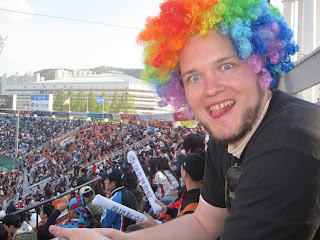
                                                          3. Lively spectators. I love a baseball game. Most any baseball game. Sometimes a crowd just isn't into it. Not so with the home crowd at the Giants' games. The crowd is pure electric. I've told you about the cheers, the songs, and the availability of copious amounts of beer. What elevates all of that is the dedication of the fans. They are in it until the end of every game. It's a party in the crowd and everyone is invited. Our seats were loud, super loud. It was like being back at a metal show in America, almost. It's not like metal shows have cheer leaders with a costume change per inning, but you get the point. The stands shook when the dancing girls started up. On top of that, the fans bring their party supplies to the game. Home made pompons from that day's sports sections are one of my favorites. Also the inflatable fingers, not foam, make a game day easily packable, yet fun to be at. The best comes around the 7th inning. Bright orange, plastic garbage bags are handed out to all the game's attendees. These bags are meant for stadium goers to bag their own garbage out after the 27th out, but for the 7th and 8th innings, they become Pacific-Rim-Ralley-Caps. Flopping, bubble style for the boys, Minnie Mouse style bows for the girls.
                                                                                                                                2. Fried Chicken. Growing up a Brewers fan, I know that stadium food means popcorn, peanuts, and sausages. Encased meats of all kinds grace Miller Park back in Milwaukee, but in our adopted hometown, fried chicken is king. Fried chicken in the stands is awesome. Get it inside or outside the stadium. It almost always comes with a couple of sauces and sometimes chopsticks. The chopsticks are nice, but isn't stadium food meant to be eaten with your hands. Oh yeah, get yourself a chicken glove, basically a Subway sandwich artist plastic glove, but it keeps the fingers clean and keeps the chopsticks in the box.
                                                                                                                            1. The price. Lets get real. I love the Brewers, but it can cost ton to visit the old ball park. $50 can get you to the lower level on the first base side for a game back in Milwaukee. In Sajik, we had premium seats for a grand total of 10,000 won a ticket. Lower level, right above an in-stadium 7-11.        
                                                                                                     
Lotte Giants Game from Shane Ebel on Vimeo.

Busan baseball, how I love thee, let me count the ways. Oh wait, I just did.

Saturday, June 18, 2011

Toast Magic

The always friendly, always smiling ladies who operate our favorite toast stand right outside the gate of Pusan National University can see us coming. Those two insatiable foreigners who can't get enough of the chewy, steamy hot toasts. 
                                                                                                     
"Toasts?" you ask. Sounds like something you can just make at home, you know, with a simple slice of bread. False. Enterprising street food vendors have come up with something infinitely more delicious and awesome than that.                        
                                                                                                               
A toast (토스토) really just a sandwich that has been all toasted up on a flat top grill. You can find these toast stands all over the place, but for Shane and I, the best place is the pedestrian street right in front of the PNU entrance, a street we've nicknamed "Toast Street." Along with the toasts, Toast Street has fresh fruit smoothies, waffles, deep fried goodies, and some places that have more traditional Korean fare.                                                                                               
Each stand has its own specific recipe for making toasts (we've heard it said that in PNU, one puts on apple slices!), and we haven't tried them all, but our favorite we've had so far is at the stand directly in front of you as you walk toward the gate.                                                                                                   
The ladies start by throwing three slices of white bread onto one grill. On the other, bright yellow-yoked eggs are cracked into a mold that makes them just the right shaped square for the bread and are scrambled up with a chopstick. Back on the bread, either a slice of ham, a slice of processed American cheese (I know. In any other case, processed American cheese is to be shunned to the extreme.), or tuna is added, depending on your order. Then on go sauces one, two, and three: ketchup, something light orange, and mustard. Finally, they throw on small handful of finely shredded cabbage. The triple decker comes with its own paper holder so that your fingers don't get all greasy as you eat. 
                                                                                                   
Okay, so on paper, maybe this sandwich doesn't sound that appealing, but don't be fooled. These are some great, comfort foods. Really top notch satisfying and delicious. Oh, and have I mentioned that the ham or cheese version costs only ₩1,500 and the tuna upgrade just ₩2,000 (about $1.40 and $1.80)?         
                                                                                                       
We've taken almost all of our out of town visitors for a toast. It's become a ritual for us that on Friday nights, we might head out for a celebratory, end of week toast. After a long week at the hagwon, sometimes we just need to fill our belly with something stuffed with egg and cheese.

Monday, June 06, 2011

In the Neighborhood: Oncheoncheon Citizen's Park

I'm unsure of the actual length of the Oncheon-cheon Citizen's Park in Busan, South Korea. The stream runs through Dongnae-gu, Yeonje-gu, and Busanjin-gu, and just footsteps outside our apartment building near the Pusan National University of Education.

The sign posted near where I enter says the park's 2,062 km long. Even with my lack of metric system comprehension, I know that cannot be right. What I do know is that I love this park, and I'm really grateful for its presence.

I'm usually down at the stream at least twice a day, enjoying the green-space that the good people of Busan have provided. Here's a list of the features I think are most awesome:

13. Hand-weeded grass, bushes that spell neighborhood names, and other immaculate landscaping

12. Contests, games, & entertainment that the district frequently sponsors like the ones where we've seen traditional games, k-pop dance demonstrations, corn-flavored treats shaped like parasols, and opera


11. Large birds. There's a pair of grey herons that have been hanging around a lot since the spring, and a very nice mallard family lives up near Dongnae station. 


10. Grass that has now grown taller than me and listening to the wind blow through it. 


9. Flowers planted in uniform lines, bulls-eyes, and other entertaining shapes 


8. The near-constant stream of upgrades that make the park better every week 


7. Acupressure foot massages that soothe your weary feet


6. Visual trickery that hides away 
those ugly path blemishes from view


=5. The Q-bert-like steps, great for doggie obstacles and for sitting and enjoying a cold bottle of Cass or makkeoli on a summer night


4. Stepping stones across the stream that make your walk feel like an adventure


3. Feeling like a very minor celebri-tay because people always stop us to pet Diga (though sometimes this borders on weird, like the time Shane was asked his opinion on segregation)


2. Very well attended community aerobics and jazzercise classes

1. Side by side pedestrian and biking paths, on both sides of the stream and loads of public fitness equipment