Showing posts with label Buddha. Show all posts

Sunday, October 30, 2011

Going to Gyeongju II: Hiking Namsan and Other Soul Satisfying Fare

Our day trip begins at a traditional restaurant that had obligingly opened early to accommodate our group of six. As soon as we settle down onto the floor mats, side dishes (called banchan, 반찬) and mountain vegetable bibimbap (sanchae bibimbap, 산채 비빔밥) mix-ins start arriving on our table. This will be our fuel during the all-day hike ensuing right after breakfast.  Today is devoted to conquering Namsan Mountain in Gyeongju.


A bowl of sanchae bibimbap starts with a bowl of sticky white rice topped with vegetables. Ours had spinach, bean sprouts, onions, mushrooms, and various unidentifiable green and twiggy mountain vegetation. To that, we each add some red pepper paste (gochujang, 고추장) or fermented soybean paste (doenjang, 된장).  


I ate up all the spicy, tangy-dressed lettuce salad and most of my bibimbap. Our other banchan included green pancakes, fried zucchini, marinated mushrooms, fish, radishes, and more. At the end, we were treated to some homemade sweet rice drink, which I'm pretty sure is called shikhae (식헤). It was light and sweet and cold, and really really delicious.
                                                                                                                                                          From the restaurant, we started onto Namsan Mountain's (남산) western face, entering near three mounds that are the Samneung Three Royal Tombs (삼릉). These tombs hold the remains of three Silla Dynasty kings: Adalla, Sindeok, and Gyeongmyeong, the 8th, 53rd, and 54th rulers, respectively.


Just a short way up the Samneung Valley (삼릉골) trail that would lead us further and further into the Namsan District of Gyeongju National Park, we see our first Buddha of the day, perched up straight but whose head was taken from him at some point.  
                          
After this one, we pass a handful more of the Buddhas scattered over Namsan. They look relaxed and untroubled. Our group stops and takes photos at each, admiring how long they've been there and the care it took to carve and assemble them. My favorite is pictured below. He's the Seated Stone Buddha, sitting on a lotus petal and expelling evil by touching the ground. It was made in the 8th or 9th century, with some restoration work done just a couple years ago. 


Next, we encounter six figures etched onto the side of a rock. Two are Buddhas, four Bodhisattvas. We have to study the rock for a few minutes to allow our eyes to follow the intersecting lines.


The most awe-striking Buddha of the day is the seven-meter-tall seated Seokgayeorae image carved on the side of Namsan. He directly looks at the Geomobong peak. Our hike takes us directly past the Buddha, and later on, we get a second view from higher up.


When we make it to the peak, we stop and fuel up with some PB&J's. There's no view from this peak, since we're completely surrounded by forest at this moment. The first treasure on our descent is this three story stone pagoda. The view from here is incredible. There used to be a temple here where the first Korean novel, Geumosinhwa, (written in Chinese) was authored. 


Our hike gets a little tenuous when we have to perform some fancy repelling action. Actually, the whole little part where you need the rope is maybe eight feet tall, but still, awesome.


The last major Buddha we pass on the way down is a seated stone Buddha from the eighth century. Like his friend from earlier, his head has gone missing sometime over the years. He's sitting atop a three wheel pedestal.


We're all famished after our hike, so we hop on the city bus and head toward the more central area of Gyeongju. Dwayne and Yuhee lead us to Sampo Ssambap (쌈밥) Restaurant for a little lunch. Ssambap is when you take some sort of leaf, maybe lettuce or cabbage, and wrap it around some rice, a little meat, condiments, banchan, whatever your preference is. This is awesome in an of itself, but this place was serving up ssambap to the extreme! Out came bowl after bowl after bowl! Side dishes, pastes, fish, meats, custards, until the dishes were completely covering our table! And all this for ₩10,000 per person (aprox. $9). 


After dinner, not quite ready to end our day, we go to one more place for a drink before home. We walk along the backside of a park until we happen upon a restaurant. The place is packed, and rightly so. It's incredibly atmospheric, an open-air restaurant with courtyard tables as well as private tables in side rooms. It's called Dosol Maeul (도솔마을), which means "Stone Pot Village."


We order an appetizer, a mixed tempura-fried vegetable platter that included some tofu and lotus, and some Korean rice wine, dongdong ju (동동주). We are told that dongdong ju is makkeoli's more formidable cousin in terms of it's strength. The taste is unique but really refreshing and delicious. 맛있어요!


When we're all sufficiently fat and happy from the snacks, drinks, and fresh air, we start our walk back toward the intercity bus terminal. Once again, Gyeongju has been a revitalizing and relaxing respite away from Busan. I'm sad to see the day over, but there will be at least one more trip back in our future. 


For more on visiting Gyeongju, see my post on our first trip there.

Sunday, July 24, 2011

Sister Visits Busan

Note: This guest post was written by my sister, Crystal, who visited Busan with her husband, Nick, back in March 2011. We thank her for her contribution to Soju Cocktail and for visiting way over here.

A lot has changed since we left Busan on March 14th; we found out that we are having a second baby, we traveled to Arkansas for yet another music festival and we traded our responsible family station wagon in for a “ridiculous” VW bus in which to create family memories. 
But one thing that hasn’t changed since then is how much I loved getting the invitation and opportunity to travel across the world to visit Rose & Shane. Visiting South Korea is something Nick and I would have never done if it weren’t for family being there. I’m super glad that they decided to become temporary residents in what Rose calls “The Land of Contrasts” so that we were able to enjoy all that Busan has to offer.
The contrasts Rose was talking about were instantly apparent. One of the most memorable was the obvious division between the generations of women, the younger generation obsessed with perfecting their faces while the older generation was obsessed with gutting their fish. I never encountered a young lady who didn’t have her eyeliner on to go hiking, and I rarely laid eyes on an older woman who could stand straight after squatting over a pail of fishy entrails. It wasn’t just the people that showed these contrasts, but the scene itself. The bustling city streets set itself against peaceful mountain paths in a way that kept making you forget that the other even existed. Then there were the modern technological advances surrounded by the remnants of past wars; people were taking pictures of rusted barbed wire fences with what looked like a smaller, better Ipad. It was magnificent. And it was fun.
The first night we arrived, Rose & Shane took us to a Korean BBQ. As I will most likely say about almost everything we did while in Busan, the Korean BBQ was definitely one of my favorites. The family-sized portion of meat comes to you raw and then you cook it yourself on a hot skillet or grill set in the middle of the table. When done to your liking, you wrap it in lettuce or sesame leaves and choose your other assorted toppings, like roasted garlic, kimchi, or a spicy sauce. You eat the little wrap with a nice, light, watery beer named Cass or with Soju. I liked the BBQ so much, I requested to go back at least three more times during our visit. 

The next two days were spent at temples. The first temple we visited, Beomeosa, is the temple all the traveler’s websites tell you to go to. Although impressive and large, it was nothing compared to the temple we visited next, Hae Dong Yong Gung. Hae Dong Yong Gung is set atop a rocky shoreline of the Sea of Japan. It has many multi-sized Buddhas, fresh spring water to drink, beautiful temples and scores of worshipers. It was a place to be at peace.
It was not quite so peaceful when we made the trek back in the city. We visited the busy markets in the streets and sampled different street foods. Every street was packed with hungry people looking to buy and sell goods and services.  Although they all looked exactly the same in my eyes, Shane was able to bring us to one 3x5 table that was making these crazy pancake type dishes, filled with chives and who knows what else. I will have to say, whatever they put in there, it was delish.  
One of the great things about Busan is that even though it’s a busy city, it only takes the short walk of a block to get back to peace. The city is on the shoreline, so we were able to spend some time on the beaches as well. Even when in a winter jacket, a beach is relaxing. Watching the water come in, writing messages in the sand, taking pictures with your friends to put on your next record cover, life is good when you’re on the beach.
Did I mention this was all just in the first 2 days?

Thursday, July 21, 2011

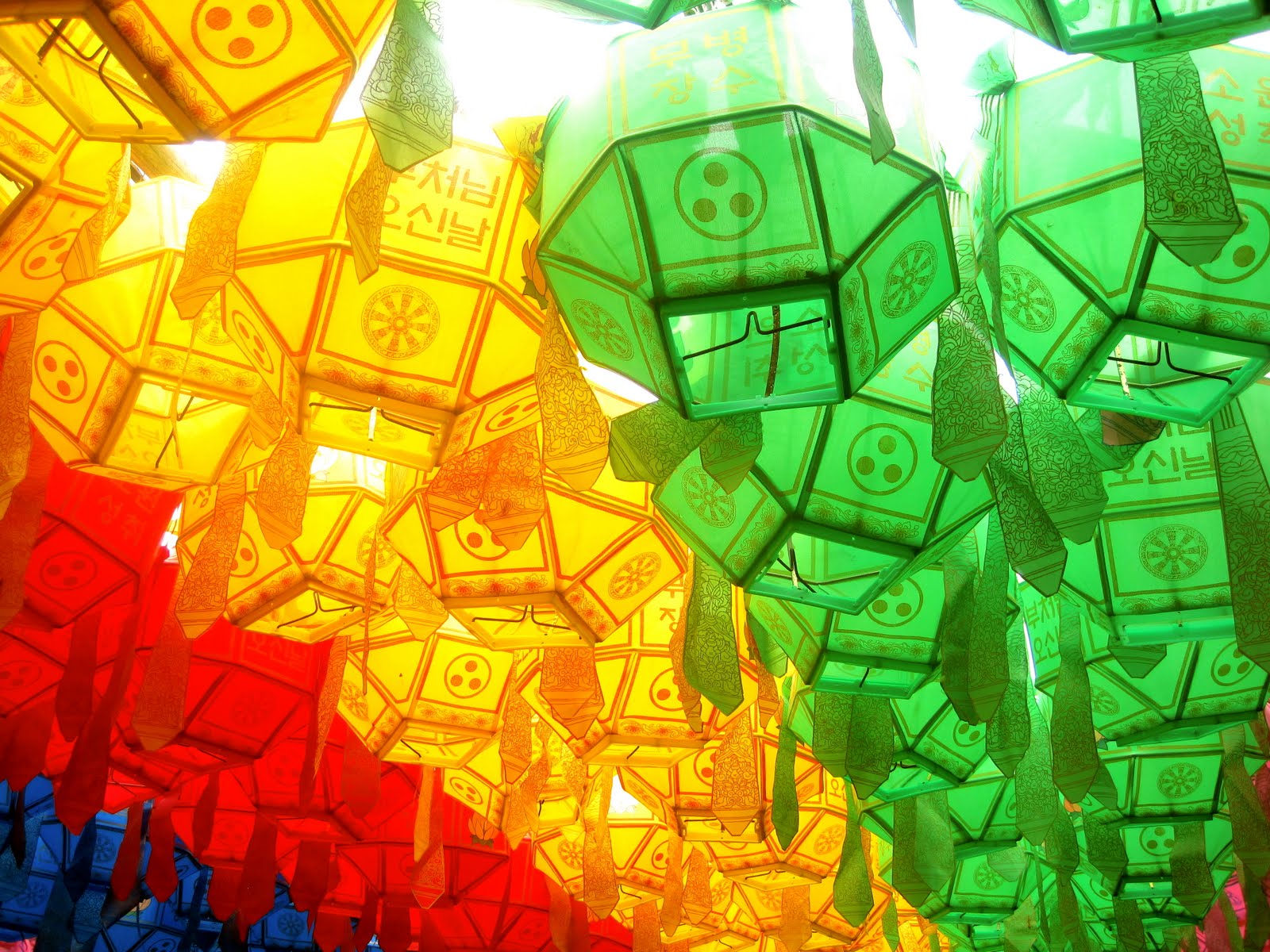
Lantern Kaleidoscope for Buddha's Birthday

Buddha's Birthday is not a holiday I normally celebrate. I've still never really celebrated it, although I did have the day off from work. I knew the day was coming weeks in advance, since ordinary city streets gradually became lined with long strings of colorful paper lanterns. It's a beautiful religion I know little about.
                                                                                                               
A few days before Buddha's Birthday, or Welcome Buddha Day, which fell back in May in accordance with this year's lunar calendar, my friend Miranda flew over from her adopted homeland of Japan to experience all that is Korea. Naturally, we had to sightsee. Off we went to Haedong Yongungsa, a beautiful temple at the edge of the city. We had never seen it like this before:


Sunday, June 19, 2011

Beomeosa: Temple of Fish from Heaven

On most of the must-do tourist lists and in guidebooks, Beomeosa rates as one of the most important tourist sites in Busan. It was one of the first sites I learned about while researching the city that would be my future home, and I looked forward to seeing the well-known temple. When my sister and brother in law visited Busan back in March, we spent a weekend afternoon at the temple.

Although buses run the route from the bottom of Geumjeong Mountain to Beomeosa, we decide to hike up. The hike itself is pleasant; not too steep, with cool views. Once nearer to the temple, we pass vendors selling coffee concoctions, assorted snacks, and vegetables from their garden plots. 


Once at the temple grounds, we start at a small grove that even on this pre-spring-bloom day is beautiful and hushed. Signs tell us that this is the wisteria woods. Only a few feet off the sidewalk to the temple structures, we feel secluded.  
Beomeosa was founded over 1300 years ago by a monk. A Korean Tourism website tells this story about it's founding: 
                                  "There is a well on the top of Mt. Geumjeongsan and the water of that well is gold. The golden fish in the well rode the colorful clouds and came down from the sky. This is why the mountain is named Geumsaem (gold well) and the temple is named 'fish from heaven'."


We leave the wisteria woods and go toward the main complex. Fragrant incense tinges the air as we walk by the open doors some structures. Inside, sock-footed worshipers bow before the Buddha statues or sit cross-legged on mats fingering beads. Shane snaps a few pictures of Crystal doing yoga poses, entries for a contest her yoga studio back home is holding.  
Suddenly, the placid atmosphere is interrupted by a chainsaw. Power tools. Here. Of all places. They're constructing a new building, and lumber and bright yellow construction barriers are set up not quite out of sight. I suppose that even ancient Buddhist temples need their renovations. 
                                 
Inside the temple gift shop, we're greeted by a petite, sweet woman who tells us she used to live in the States. She helps Crystal and Nick pick out some incense and a tiny Buddha figurine they will take back as a special memento for their two year old son.                        
Beomeosa's a cool place; there's an air of zen and it's worth a see. However, it just doesn't have the magic that we thought it would after reading so much about it. I guess this temple doesn't have the flash that some other temples have, but how much flash should there be at a place of meditation and contemplation? 


Friday, May 06, 2011

Buddhas by the Sea

Sometimes I sit back and wonder when my life took the turn such that it's not out of the realm of everyday possibility to spend a few hours exploring a Buddhist temple next to the sea. How'd I get so damn lucky? 
                                                                                                               
Crystal and Nick's visit in March prompted Shane and me to do some sightseeing around town that after seven months in Busan, we still hadn't gotten around to. 
                                                                                                     
Haedong Yongungsa is the most beautiful temple of the small handful I've seen. It sits next to the East Sea on the northeast coast of the city. After entering through a busy marketplace thoroughfare, serene temple grounds. Sweet strong incense. Bamboo stalks. Children touching statues.                                                       
                                                                                                              
I scan the rundown of Haedong Yongungsa's history. I read: "The most merciful Boddhisattva Avalokitesvara who reincarnated unlimited love and mercy was said to stay at such a lonely shoreside some times with a special presentation of riding on a dragon in a flame." The temple was originally built in the 1300's, but like others, was burned to the ground during the Japanese invasion of 1592. The sign tells me this is the "King's Dragon Palace" temple, a "floating Buddhism sanctuary showing a wonderful view of dark-blue seas and breaking white spilitering [sic] water just like fresh touching on your feet."                          
                                                                                                        
Apt. Lovely.


Sunday, March 06, 2011

Jangsan Hiking, Busan Daytripping

The top of Jangsan rewards those who reach it. The very tippy top of the mountain is chain-link fenced off, a relic of the Korean War, but from where we stand the views are wide. We summited the Haeundae area Jang Mountain after about four and a half hours of hiking, and from here, we can see Haeundae Beach, Centum City, Sajik Stadium, and a small wildfire with a helicopter making a beeline towards it with its load of extinguishing chemicals. A bit unsettling, but it looks under control. 


Shane and I sip red table wine out of plastic Dixie cups along with the rest of the Busan Daytrippers. We found this crew, an ever-changing mashup of folks who get together to hike Busan's thousands of paths, on a local expat forum. They're a fun bunch, the kind of people who think of bringing wine along. 


In the couple hours leading up to this faultless moment on the way up, we had passed by Pokposa, a Buddhist temple. It's Lunar New Year's Day, a traditional day for worship, and it's semi-crowded, yet quiet and peaceful. There's a bowl of fresh fruit and incense on the altar in front of a ten story pagoda, and a grey stone Buddha that faces every direction at once. We hear soft chanting floating out through the temple doors, and we peek into the temple buildings, feeling like voyeurs intruding into a sacred time and space.  


We hike on for a long while, until we reach stop number two. We approach a shack, which our leader Joe tells us is a great little stop for some mountain food. After a few minutes of our searching, an old man crawls out of his sleeping shack (it's now about one in the afternoon), and brings us makkeoli, followed by the freshest tofu I've ever tasted and savory, pungent kimchi. Ten of us laugh and eat and celebrate how good it is to be alive, looking over the mountains and the sea. 


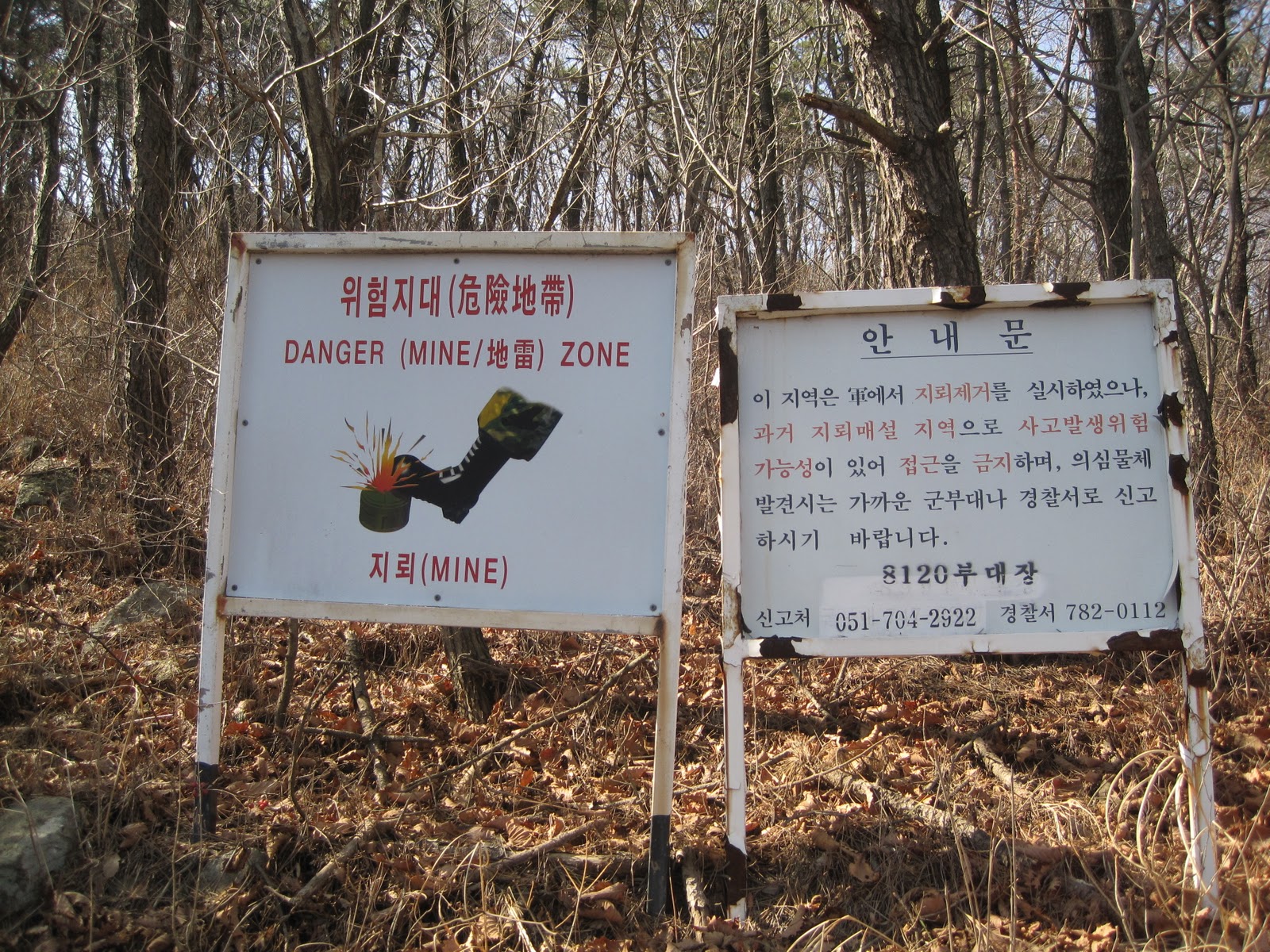
Feeling renewed, we continue the hike, walking for a time along a barbwire edged land mine field, here in the middle of a metropolitan city, another lingering remainder of the Korean War. When we come out of this forested length of the hike, the landscape opens up and we're walking the perimeter of a tall grassed field, the kind I'm used to seeing back in the Midwest. This kind of openness is such a rarity here.


After our wine and photo ops on the top, we head down the opposite slope of the mountain. As we come down through the trees, in the distance I see a golden Buddha contrasting against a pine backdrop. When we arrive to Seongbul Temple ten minutes later, we're greeted with the light sweet smell of incense, stone lanterns, and a ten story pagoda. We watch Koreans bow and meditate and pray in front of the Buddhas, and our hike ends with the beauty of Buddhism.