Showing posts with label park. Show all posts

Sunday, July 24, 2011

Sister Visits Busan

Note: This guest post was written by my sister, Crystal, who visited Busan with her husband, Nick, back in March 2011. We thank her for her contribution to Soju Cocktail and for visiting way over here.

A lot has changed since we left Busan on March 14th; we found out that we are having a second baby, we traveled to Arkansas for yet another music festival and we traded our responsible family station wagon in for a “ridiculous” VW bus in which to create family memories. 
But one thing that hasn’t changed since then is how much I loved getting the invitation and opportunity to travel across the world to visit Rose & Shane. Visiting South Korea is something Nick and I would have never done if it weren’t for family being there. I’m super glad that they decided to become temporary residents in what Rose calls “The Land of Contrasts” so that we were able to enjoy all that Busan has to offer.
The contrasts Rose was talking about were instantly apparent. One of the most memorable was the obvious division between the generations of women, the younger generation obsessed with perfecting their faces while the older generation was obsessed with gutting their fish. I never encountered a young lady who didn’t have her eyeliner on to go hiking, and I rarely laid eyes on an older woman who could stand straight after squatting over a pail of fishy entrails. It wasn’t just the people that showed these contrasts, but the scene itself. The bustling city streets set itself against peaceful mountain paths in a way that kept making you forget that the other even existed. Then there were the modern technological advances surrounded by the remnants of past wars; people were taking pictures of rusted barbed wire fences with what looked like a smaller, better Ipad. It was magnificent. And it was fun.
The first night we arrived, Rose & Shane took us to a Korean BBQ. As I will most likely say about almost everything we did while in Busan, the Korean BBQ was definitely one of my favorites. The family-sized portion of meat comes to you raw and then you cook it yourself on a hot skillet or grill set in the middle of the table. When done to your liking, you wrap it in lettuce or sesame leaves and choose your other assorted toppings, like roasted garlic, kimchi, or a spicy sauce. You eat the little wrap with a nice, light, watery beer named Cass or with Soju. I liked the BBQ so much, I requested to go back at least three more times during our visit. 

The next two days were spent at temples. The first temple we visited, Beomeosa, is the temple all the traveler’s websites tell you to go to. Although impressive and large, it was nothing compared to the temple we visited next, Hae Dong Yong Gung. Hae Dong Yong Gung is set atop a rocky shoreline of the Sea of Japan. It has many multi-sized Buddhas, fresh spring water to drink, beautiful temples and scores of worshipers. It was a place to be at peace.
It was not quite so peaceful when we made the trek back in the city. We visited the busy markets in the streets and sampled different street foods. Every street was packed with hungry people looking to buy and sell goods and services.  Although they all looked exactly the same in my eyes, Shane was able to bring us to one 3x5 table that was making these crazy pancake type dishes, filled with chives and who knows what else. I will have to say, whatever they put in there, it was delish.  
One of the great things about Busan is that even though it’s a busy city, it only takes the short walk of a block to get back to peace. The city is on the shoreline, so we were able to spend some time on the beaches as well. Even when in a winter jacket, a beach is relaxing. Watching the water come in, writing messages in the sand, taking pictures with your friends to put on your next record cover, life is good when you’re on the beach.
Did I mention this was all just in the first 2 days?

Sunday, July 17, 2011

Going to Gyeongju

Tumuli. Tumuli. Tumuli. It's fun to say. They're also fun to look at, these giant round mounds popping up around the city of Gyeongju (경주시). The tumuli are actually tombs of the Shilla kings and rulers of ancient Korea. One, called Cheongmachong (천마총), or the Heavenly Horse Tomb, is opened for sightseers to go inside. It's dark and cool, and a little disconcerting when I see that I'm inside a pile of rocks about fifteen feet deep that is covered with dirt ten feet deep. Also, you're standing inside someone's grave.

                                                                                                            
In the tomb, we marvel at artifacts like an uncomfortable-looking wooden saddle and a fragile gold headdress. Shane, Mom, Britt, and myself wander through the rest of Tumuli Park, grateful for the cloud cover that are keeping us cool. It's so nice to be surrounded by fresh air and green. 


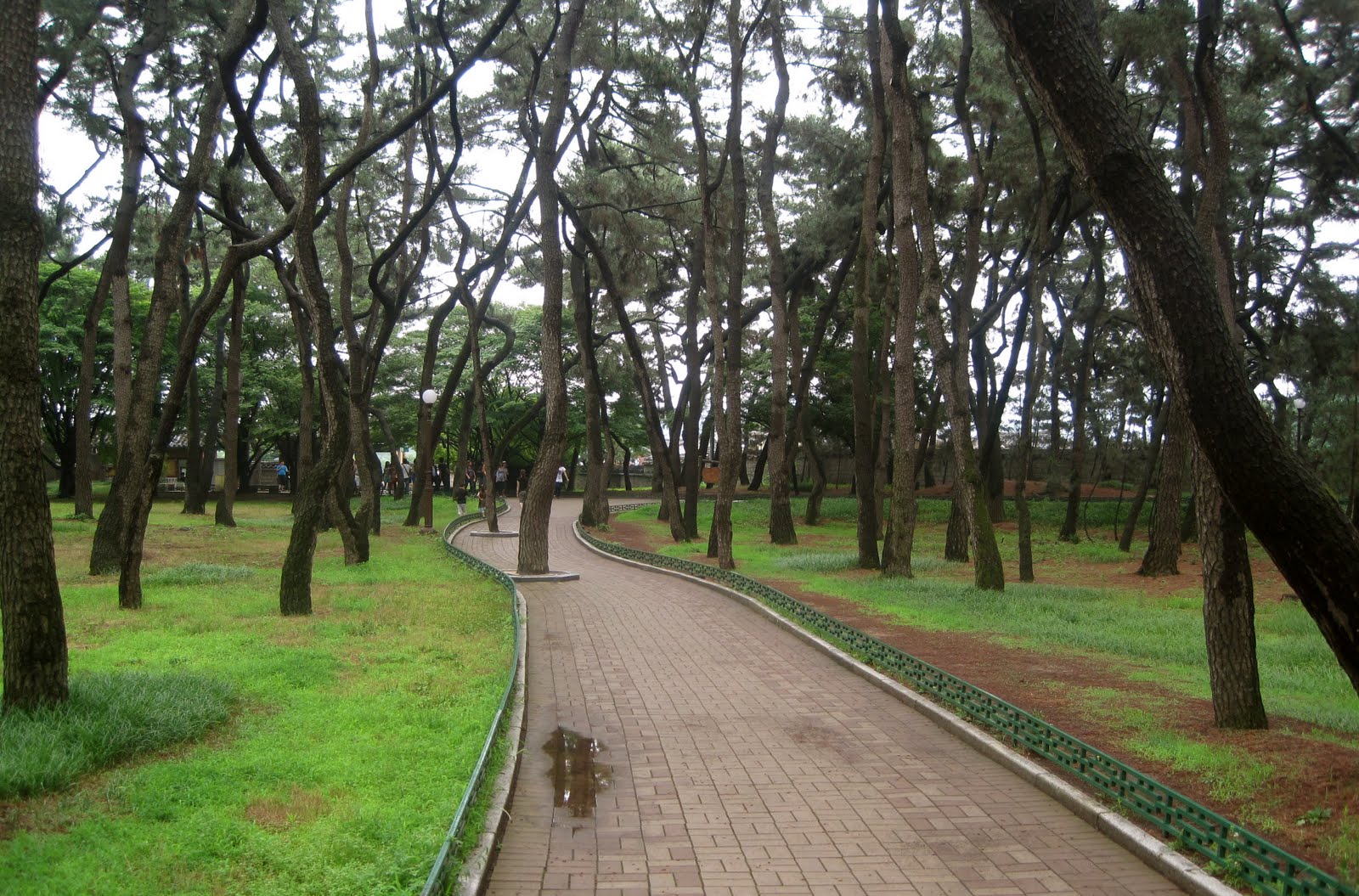
The path through Tumuli Park leads us through a stretch of gnarly knotty trees. Because of the rain that has just passed through, the park is nearly empty and very still. Smells fresh and mossy and I feel like I'm in a children's storybook. We walk on.


After a bit, we reach a place I recognize from my student's textbooks. I'm standing in front of Cheomseongdae (첨성대), the oldest astronomical observatory in East Asia. Seeing this landmark now in person is so anti-climatic that I have a hard time believing it's actually a big tourist site. It looks like a pudgy chimney. I'm the only one in our group who takes a picture. 

                                                                                             
Unimpressive landmarks aside, the open, wide expanses of Gyeonju's historical section are serene and calm and beautiful and impress me much more. 
                                                                                                          
We had come here with the intention of seeing a piece of Korea outside of Busan's confines. As much as my mother and sister enjoyed the city, we all  needed respite from the hot urban summer. So we jumped on the KTX, the high-speed train that connects Korea end to end, and an hour later we were at this UNESCO World Heritage Site


From Cheomseongdae, we sojourn across a field toward another wooded area, which a sign informs us is Gyerim Forest (계림). The post goes on to explain that this is the place where a gold box was found hanging from a tree, with a rooster crowing underneath it, and in that box was a boy who's heirs would later rule the Silla dynasty. Britt and I are eyed up by two ajumnas while Mom and Shane try to take pictures of a cool blackbird.

                                                                                                       
Later, after walking through the rapeseed field, past the red and white hollyhocks, under the gourd and zucchini vine-covered tunnel, and after taking turns sticking our faces through a painted board that made it look like we were the Shilla princess in a pink hanbok riding a white horse sidesaddle, we make it to Anapaji Pond (안압지)
                                                                                                          
I've never seen so many or such huge water lilies. The leaves are larger than my head. By the time we finish walking up and down the pathways, we're tired and ready to head toward the bus station.


To get there, we have to walk down Hangover Soup Street. Hangover soup (haejangguk or 해장국) is a traditional stew made from ox or beef bone broth, soybean paste, sprouts, radish, green onions, and sometimes ox blood. Today, each of the hangover soup restaurants is nearly identical, and each is empty, save the proprietors swatting flies away from giant silver pots. I guess that by 3:00 in the afternoon, the hangovers are done for the day. 


Monday, June 06, 2011

In the Neighborhood: Oncheoncheon Citizen's Park

I'm unsure of the actual length of the Oncheon-cheon Citizen's Park in Busan, South Korea. The stream runs through Dongnae-gu, Yeonje-gu, and Busanjin-gu, and just footsteps outside our apartment building near the Pusan National University of Education.

The sign posted near where I enter says the park's 2,062 km long. Even with my lack of metric system comprehension, I know that cannot be right. What I do know is that I love this park, and I'm really grateful for its presence.

I'm usually down at the stream at least twice a day, enjoying the green-space that the good people of Busan have provided. Here's a list of the features I think are most awesome:

13. Hand-weeded grass, bushes that spell neighborhood names, and other immaculate landscaping

12. Contests, games, & entertainment that the district frequently sponsors like the ones where we've seen traditional games, k-pop dance demonstrations, corn-flavored treats shaped like parasols, and opera


11. Large birds. There's a pair of grey herons that have been hanging around a lot since the spring, and a very nice mallard family lives up near Dongnae station. 


10. Grass that has now grown taller than me and listening to the wind blow through it. 


9. Flowers planted in uniform lines, bulls-eyes, and other entertaining shapes 


8. The near-constant stream of upgrades that make the park better every week 


7. Acupressure foot massages that soothe your weary feet


6. Visual trickery that hides away 
those ugly path blemishes from view


=5. The Q-bert-like steps, great for doggie obstacles and for sitting and enjoying a cold bottle of Cass or makkeoli on a summer night


4. Stepping stones across the stream that make your walk feel like an adventure


3. Feeling like a very minor celebri-tay because people always stop us to pet Diga (though sometimes this borders on weird, like the time Shane was asked his opinion on segregation)


2. Very well attended community aerobics and jazzercise classes

1. Side by side pedestrian and biking paths, on both sides of the stream and loads of public fitness equipment


Saturday, May 14, 2011

Cherry Blossoms Next Door

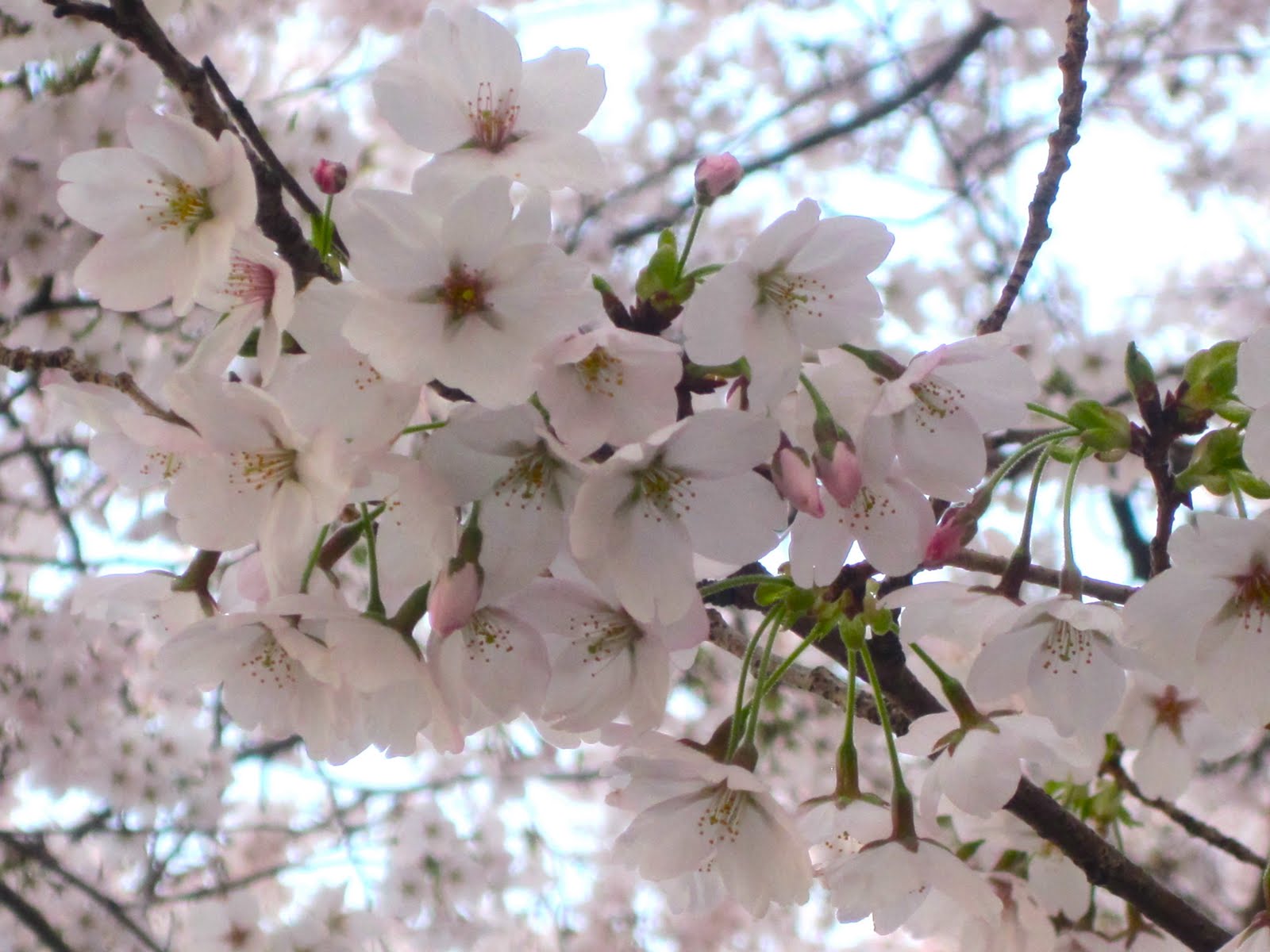
These photos were taken at Oncheonjang Stream, a stretching park running just outside our door. As the cold winter faded to spring, we waited while the cherry trees prepared themselves for the blossom filled spectacle that would stick around for nearly two weeks. What a gift.

The blossoms hug each side of the park. Makes the wide space feel cozy. 

You can't see all the letters in the picture, but the bushes spell out
Yeonje-gu, the name of our neighborhood.

The air was fragrant, and reminded me of lilacs bushes back stateside.


The blossoms called for a giant festival, of course. Festivities included throwing sticks in buckets,
advertising models spinning prize wheels, opera recitals, and dozens of food carts all
selling the same deep fried but now cold food. It was much more fun than it sounds. Really.

Tuesday, May 10, 2011

Good Day, Igidae

Our eyes scan the rocks under our feet, looking for the footprints of the long extinct Ultrasaurus. It’s been awhile since I’ve gone on a dinosaur print hunt. Okay, I’ve never actually tried to find dinosaur prints before, and it doesn’t look like I’ll be successful today. We conclude they the prints must actually be these foot-wide indentations now filled with shallow pools of water. 
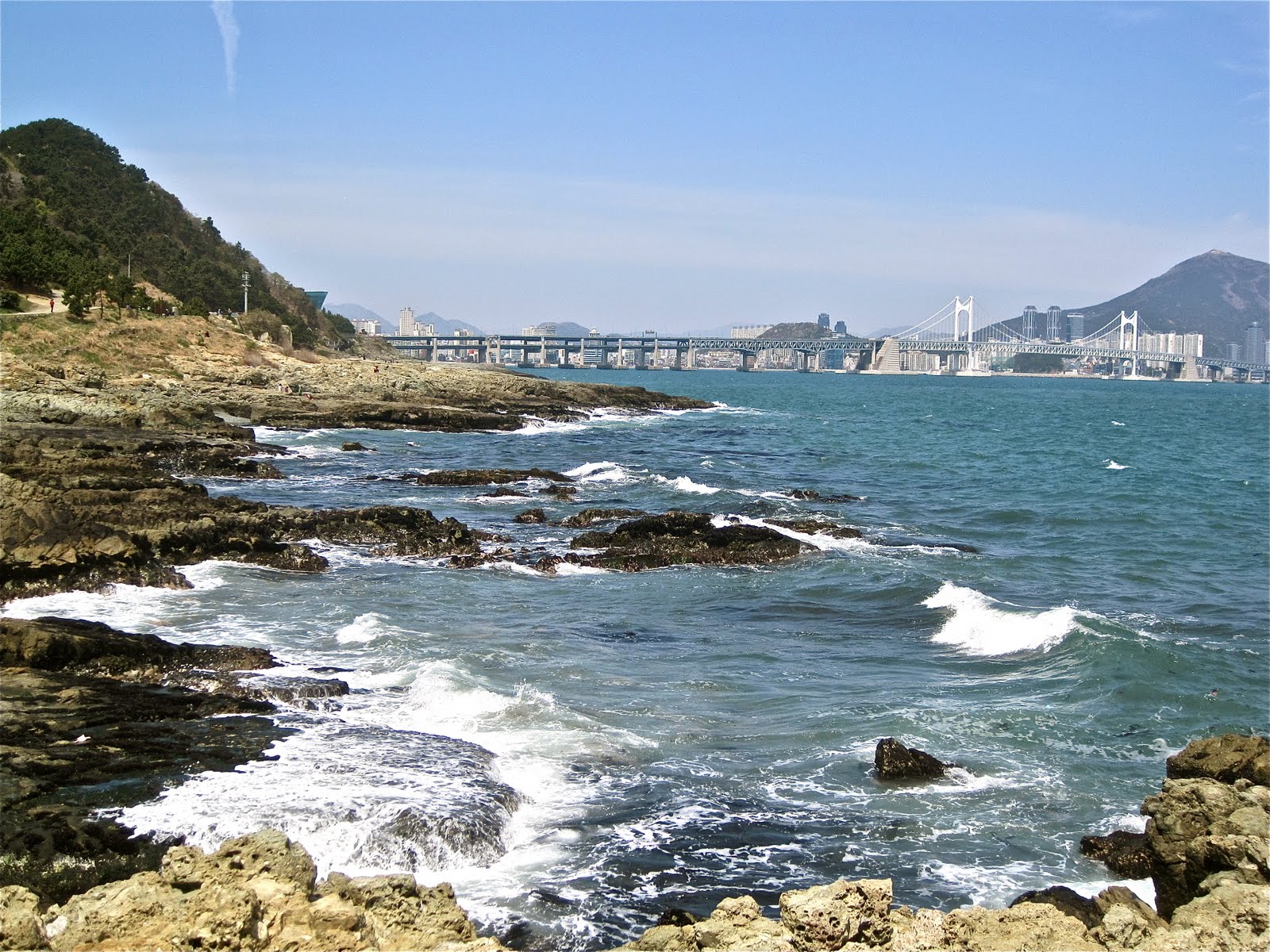
Igidae Park (이기대)  in Busan is a perfectly lovely way to spend an afternoon. The waves crashing on the rocks, one and another and another, a consistent white-noise murmur that subdues me into feeling more relaxed than I have in a long while. 
The Igidae coastal walk stretches out on the southwestern shoreline of Busan. Our taxi driver drops us near the middle of the path. We follow it along the shore, pass couples sharing ramen, families sharing picnics, fishermen sharing time with the sea. We run into some former students, twins who were some of my best students. I remember how much I miss having them in class. At places, the way the sun hits the rocks hits the waves and the trees stand tall on the edge of the cliff, I flashback to once upon a time when I was in Portugal. 
Once in awhile, we come across tiny cement bunkers that were at one time manned with soldiers looking for North Korean subs. At one, a couple of men are messing around, posing as if they have guns in the metal prong barrel holders. One agrees to a photo. The war was really not that long ago. 
Later on, we pass a sign that tells us why this place is named Igidae. Like just about every other tourist sign we ever see, this one alludes to the entrenchment of the Japanese in Korean history: 
When the Japanese invaded Joseon in the late 16th century, 
they conquered Suyeongseong Fortress and held a feast 
to celebrate their victory at a high, open spot that 
commanded pleasant scenery. Two Korean gisaeng 
(female professional entertainers) were taken to the feast. 
They seized a drunken Japanese commander 
and jumped into the sea 
as a reprisal against the Japanese invasion of their homeland.  
Thus, the name Igidae, which means two gisaeng, was given to this place.  

The women’s resolve kicks ass.


I try to muster up an ounce of my own resolve as Shane and I cross suspension bridges leading back toward the subway stations. I’ve lately realized it is not heights I am afraid of, but ledges. Back on safe shoreline, we amble down onto some rocks and watch an ajoshi stacking rocks into spires, a ritual we’ve before been told has to do with seeking good luck. Shane stops and constructs a stack of his own.  

I just watch the two of them work without joining in myself. If the universe sends any more good fortune my way, I’ll burst from bogarting too much of it for myself.


Wednesday, February 02, 2011

Seoul: Olympic Park

In 1988, sprinter Ben Johnson lost his gold when he tested positive for a performance enhancing drug, Flo-Jo set an Olympic record, and Greg Louganis got the gold despite a nasty hit on the head from the diving board. It happened in Seoul. 

Twenty three years later, on a day that seems the very antithesis of summer, Shane and I survey the remains of those games, Olympic Park. The Rough Guide we often consult on these matters tell us that "there's a general air of decay about the place-- but that's part of its appeal." It's right. As we walk, we don't see many others, being winter and a weekday. The buildings look as though they are trying their hardest not to look like they were designed by a Cold War era architect. 


We continue on through to the sculpture park, exhibiting works by artists from a handful of the countries who competed. The individual monuments strike me as spartan, but the collaborative nature of the sculpture series hints at a more dramatic story. Larger works stand solitary spread over the grounds, smaller works cluster together. Olympic Park also contains a small art museum. It's nice to know that art got some attention at an event that is all about athletics.


At the front of the park, the air becomes energized. The Olympic flame continues to burn on under the colossal World Peace Gate. Flags from each participating nation still wave, including flags that have outlasted the nations themselves, like Zaire, East and West Germany, the Soviet Union, and North and South Yemen. Lots of children, on winter break from public school, ice skate on the rink next to the gate. We admire the grotesque-faced totems lining the wide walkways. 


I shiver and snap a few more pictures and Shane catches some last glimpses of the World Peace Gate. We walk to the subway, away from this serene place that once held such spectacle, toward our next destination. 


Thursday, November 25, 2010

Soft Beach, Crunchy Beach: Dadaepo Beach

In a remote Busan neighborhood called Saha-gu sprawls a remote beach called Dadaepo. Dadaepo is notable because it's got what most places here lack: the elusive and sacred sense of space. Openness. Room to breathe deeply.

Blockish high-rises tower behind the beach, but ahead is only calmly lapping seawater. Well, that and a rusty crane bewilderingly sitting on a cement platform fifty yards off the coast.

Quiet waves arrange wettish sand into neat curving ridges. Old men cast lines while young men race remote controlled cars along the shore. The beach isn't popular in November and for a few moments, Shane and I forget we're in a city of 3.5 million.

We head toward the wooden walkway built into the side a hill. On the other side of the balcony the sand turns to crunchy seashell. We scuttle on the rocks for awhile and allow the wind to blow our hair. I'm instantly in love with the tiny red rowboat anchored close to shore. 


Don’t Miss: Picking through sea glass on the shell-covered southern end. Because sometimes it's just nice to gather sea glass.


Getting There: Take Bus Number 2, 11, 338, 96 or 98 to the Dadaepo stop and walk 5 minutes to the beach. Or, take the Busan subway line one all the way to the Sinpyeong stop and hop in a taxi for a short cruise.