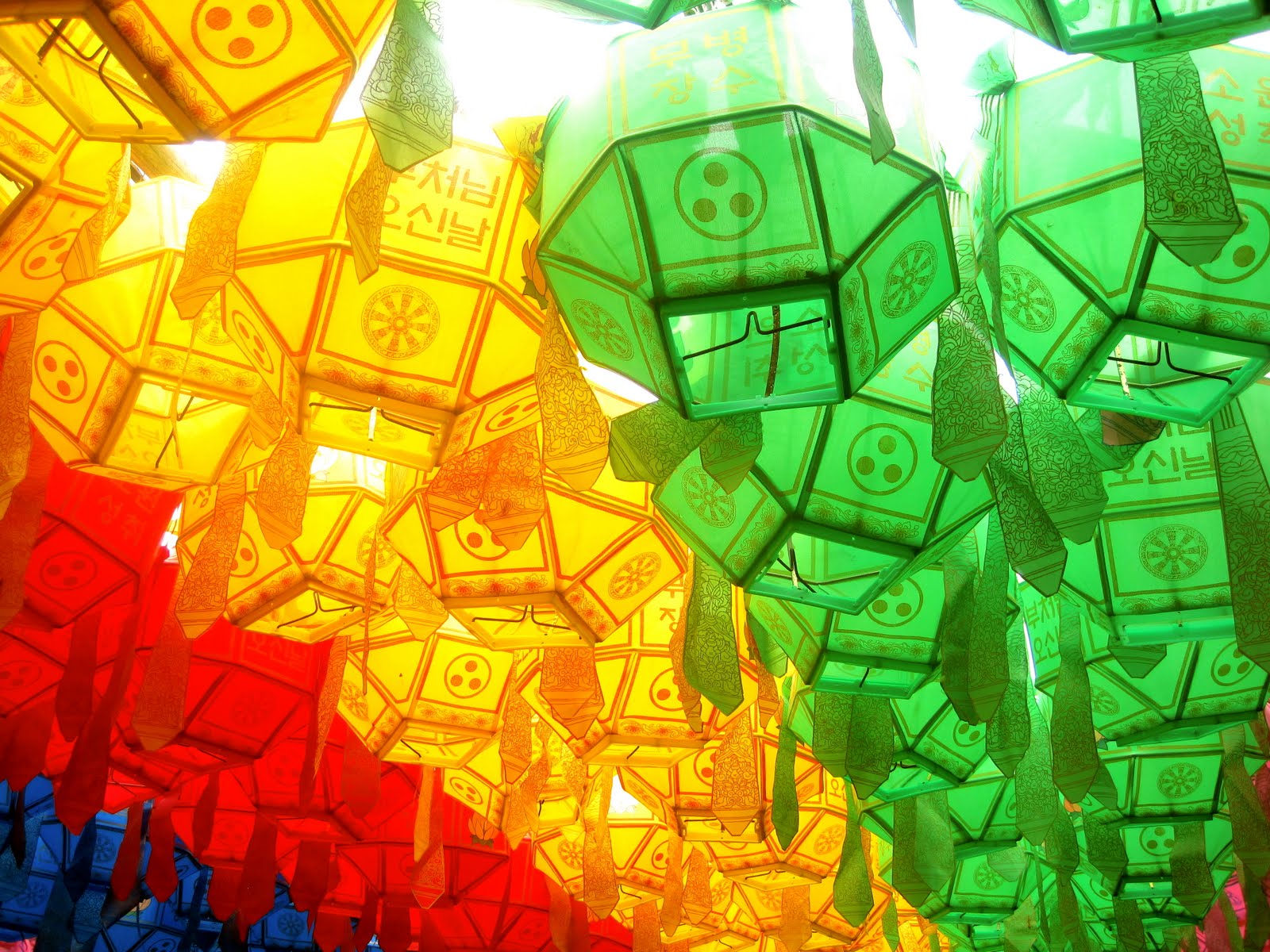
A few days before Buddha's Birthday, or Welcome Buddha Day, which fell back in May in accordance with this year's lunar calendar, my friend Miranda flew over from her adopted homeland of Japan to experience all that is Korea. Naturally, we had to sightsee. Off we went to Haedong Yongungsa, a beautiful temple at the edge of the city. We had never seen it like this before:
Showing posts with label shrine. Show all posts
Thursday, July 21, 2011
Lantern Kaleidoscope for Buddha's Birthday
Buddha's Birthday is not a holiday I normally celebrate. I've still never really celebrated it, although I did have the day off from work. I knew the day was coming weeks in advance, since ordinary city streets gradually became lined with long strings of colorful paper lanterns. It's a beautiful religion I know little about.
Friday, May 06, 2011
Buddhas by the Sea
Sometimes I sit back and wonder when my life took the turn such that it's not out of the realm of everyday possibility to spend a few hours exploring a Buddhist temple next to the sea. How'd I get so damn lucky?
Crystal and Nick's visit in March prompted Shane and me to do some sightseeing around town that after seven months in Busan, we still hadn't gotten around to.
Haedong Yongungsa is the most beautiful temple of the small handful I've seen. It sits next to the East Sea on the northeast coast of the city. After entering through a busy marketplace thoroughfare, serene temple grounds. Sweet strong incense. Bamboo stalks. Children touching statues.
I scan the rundown of Haedong Yongungsa's history. I read: "The most merciful Boddhisattva Avalokitesvara who reincarnated unlimited love and mercy was said to stay at such a lonely shoreside some times with a special presentation of riding on a dragon in a flame." The temple was originally built in the 1300's, but like others, was burned to the ground during the Japanese invasion of 1592. The sign tells me this is the "King's Dragon Palace" temple, a "floating Buddhism sanctuary showing a wonderful view of dark-blue seas and breaking white spilitering [sic] water just like fresh touching on your feet."
Apt. Lovely.
Crystal and Nick's visit in March prompted Shane and me to do some sightseeing around town that after seven months in Busan, we still hadn't gotten around to.
Haedong Yongungsa is the most beautiful temple of the small handful I've seen. It sits next to the East Sea on the northeast coast of the city. After entering through a busy marketplace thoroughfare, serene temple grounds. Sweet strong incense. Bamboo stalks. Children touching statues.
I scan the rundown of Haedong Yongungsa's history. I read: "The most merciful Boddhisattva Avalokitesvara who reincarnated unlimited love and mercy was said to stay at such a lonely shoreside some times with a special presentation of riding on a dragon in a flame." The temple was originally built in the 1300's, but like others, was burned to the ground during the Japanese invasion of 1592. The sign tells me this is the "King's Dragon Palace" temple, a "floating Buddhism sanctuary showing a wonderful view of dark-blue seas and breaking white spilitering [sic] water just like fresh touching on your feet."
Apt. Lovely.
Monday, September 20, 2010
Visit to Chungnyeolsa Shrine

The proportions on the Busan tourist map makes Chungnyeolsa Shrine appear as if it's only six blocks away from our apartment instead of two miles (but much closer if we had taken a direct route instead of getting lost in side streets). Upon arrival, we were received by this monument, six bronze fighters standing firm for ancient Korea.
Chungnyeolsa Shrine was built 400 years ago in dedication to 92 patriots- surprised soldiers and civilians- who died defending Busan from Japanese invasion in 1592. The Japanese were looking to expand their territory, but the Koreans defended
fiercely.
Beside the serene atmosphere, I am most struck by how well this national shrine is cared for. The Moon Handbook tells me that in the early 1900's the shrine fell into disrepair while the Japanese occupied the country, but it was again restored in the 70's.
The ceiling's paint is vivid, not faded. A local refreshes the incense pots while Shane and I look on. Five hundred years later, Busanites still remember those who protected them from oppression. Each of their names is inscribed on a wooden tablet inside the main upper temple. Each May, a ceremony is held in memory of the 92. One building is dedicated entirely to the four women who gave their lives, fighting as they knew how by throwing roofing tiles at the invaders in the streets below.
From the top of the shrine-- taller than one would expect-- high rise apartments and million dollar office buildings interrupt mountain views. Below, near the koi pond, there's a cafeteria, and outside the cafeteria old men play baduk in the shade. This place is a calm escape from the six lanes of traffic that swirl by only feet beyond the main gate.

Subscribe to:
Posts (Atom)